
Whether you’re putting in your first vegetable garden (Yay!) or adding to your existing garden layout, ask yourself a few questions, “What’s my garden goal? How many people am I trying to feed? How much space do I have to work with?”
What size should my veggie garden be? A very general rule of thumb for calculating how big a vegetable garden should be is about 100 SQ FT per person or family member depending on plant selection. Even with small spaces, garden layouts including vertical gardening or square foot gardening can help you grow loads of vegetables to help reach your family’s garden goals.
Let’s get to the bottom of it shall we? Let’s figure out what your goals are, what your gardening space looks like, how we can overcome smaller areas and get you growing.

What size vegetable garden do I need?
Well, let’s talk about your gardening goals, shall we?
Are you gardening for yourself, family, friends, neighbors, those in need?
Are you just wanting a small kitchen garden to snip fresh herbs as you’re cooking dinner? Do you want to harvest diner? Perhaps you want to harvest enough fruits, herbs and veggies to feed your family all year. Are you hoping to be entirely self sufficient as well as preserve or share your bountiful harvest by canning and storing for later?
Determining your garden goals can help you better calculate what size your vegetable garden should be.
Do you just want to supplement your weekly grocery shopping by incorporating a few fresh grown herbs and veggies into your daily meals? Perhaps try 50 SQ FT per person.
Do you want to grow fresh smoothie or salad greens? Try 25 SQ FT per person.
Want to grow fresh produce all summer for one person? Try 100 SQ FT. Want a year-round supply? You may want upwards of 200 SQ FT so you can preserve, pickle, can and freeze all the treasures from your veggie patch. Keep in mind you’ll need somewhere to store it like a deep freezer, basement or a root cellar.
Want some fresh herbs and maybe a tomato plant or two? Easy, That’s just a couple of potted containers! Just think, a happy, well-cared-for tomato plant can produce up to 20 pounds of tomatoes for you in one growing season. There is a lot you can do with just a couple containers!
Take note: A larger vegetable patch requires a larger time commitment. But no fear! Time-savers like cheap and easy automatic watering systems and square foot gardening can cut back drastically on the time spent out in your veggie patch… unless of course you’re out there hiding from the kids.
Not sure what 100 SQ FT looks like? (See Below for some examples)
How BIG should I make my garden?
How much space do you have to work with?
If you have enough space to till 400 SQ FT (for your family of 4) in a spot that has great drainage and at least 6-8 hours of sun, by all means do it! I’m jealous! Just remember to leave yourself enough space within your vegetable garden to fit a wheelbarrow in between raised beds or between rows to help save your back.
For the rest of us working with limited space, here are a few things to consider…
How wide should my vegetable garden be?
Unless your garden is big enough to walk through I suggest keeping it no more that 4′ wide so that you can easily reach into it’s center from both sides. For deeper, wider raised beds, use stepping stones to prevent soil compaction.
Again, If you must put your new vegetable garden in an awkward location (like up against a wall) you can still make it 4′ deep but just plan on putting a paver/stepping stone or two in the center. This doesn’t mean you’re going to stand in your garden, it just allows you a safe place to step when you lean in to reach the plants and veggies in very back.
Bonus- Decorating garden stones is a fun garden craft to make with the kiddos!
For smaller backyards, your garden layout may demand a narrow planting area. Great! You can easily build a raised bed and make it as long as you’d like, it could even be as narrow as a foot or two.
If getting enough sunlight along the side of the house is a concern perhaps a raised bed can lift your garden up out of the shadows.
Remember: When planting a garden against a wall to place your tallest plants in the back. Also, planting against a northern wall gives you the most southern exposure hence the most sun to keep your garden veggies lush and happy.
So, how big is a 100 SQ FT vegetable garden anyway?
The simplest answer would be a 10′ x 10′ garden. Let’s just assume you want to be able to reach the center…. To keep things uniform and easy-to-build you decide on making raised beds that measure 4′ x 5’… You’d need 5 beds just to feed one person. Yikes!
A couple longer garden beds could work perfectly too. Garden beds look great side-by-side especially if you bend a few cattle panels or a trellis between them to form an archway for your vining plants.
| Single person | 100 SQ FT | 5 4’x5′ beds |
| Family of 2 | 200 SQ FT | 10 4’x5′ beds |
| Family of 4 | 400 SQ FT | 20 4’x5′ beds |
If you have a nice sized property to work with, lucky you! Tilling directly into the ground would no doubt be the easiest and the cheapest way to get your vegetable garden going.
If you are interested in all the benefits of utilizing cover crops (or want to know what they are), check out my post on cover crops for the home garden… lots of them are edible too!
This is where the square foot gardening method popularized by Mel Bartholomew in his book All New Square Foot Garden comes in real handy…
Vegetable gardening for smaller spaces
Square foot gardening
The basic concept behind square foot gardening is planting your plants as closely together as possible to maximize your harvest, shade the soil to prevent moisture loss and crowd out weeds thus minimizing time spent watering, weeding and thinning your plants. Yes please!

As long as you can adequately visualize how many plants you need for roughly a 1′ x 1′ area I don’t think it’s necessary to rope off your garden into a grid like he does.
Here is a quick chart to reference:
| Plant variety | How many of each plant can fit into a 1′ x 1′ square area |
| broccoli brussels cabbage cauliflower celery corn trellised cucumbers eggplant head lettuce most herbs okra peppers tomatoes (determinate) potatoes sunflowers | 1 plant |
| beets garlic kohlrabi lettuce leeks shallots onions parsnips parsley swiss chard | 4 plants |
| peas trellised pole beans | 8 plants |
| arugula bush beans leaf lettuce scallions spinach turnips | 9 plants |
| carrots radishes | 16 plants |
Some vegetable plants need a bit more space…
| Plant variety | How many SQ FT each plant needs |
| asparagus small squash (vine) | 2 SQ FT |
| melon tomato (indeterminate) large squash (vine) | 4 SQ FT |
| bush squash zucchini | 9 SQ FT |
A quick note on tomatoes: Determinate (bush) tomatoes grow to a pre-determined size, while indeterminate varieties will grow like weeds until the frost kills ’em. Indeterminate varieties are my current favorite as they can be tied onto any support or trellis. So awesome.
I personally believe things like corn, depending on the variety, could be even more compacted. For example: I grow sweet corn in large containers fitting about 4 plants per 12″ pot. In addition they are planted with peas and nasturtiums… that’s a lot of green in one container!
Vertical vegetable gardening
Vertical vegetable gardening can take up less SQ FT on the ground by moving smaller items up onto walls, baskets or towers. Grow veggies such as tomatoes, squash, melons, cucumbers and more on trellises vertically. As a bonus vertical gardens help reduce insects and disease. Sweet.
- Trellises are a classic for good reason! A trellis is anything that your plant can grow on for support. Fences, porches, A-frames, old stepladders, posts, cages (think tomato cages), walls (by attaching lattice or cattle panels), twine/rope, trees, arch ways…
- Hanging baskets are great for a ton of plants like strawberries, herbs, greens, peas, smaller peppers, cucumbers and even cherry tomatoes!
- Shelves can enable you to stack a few containers high. While it won’t help much for taller vegetables like corn or okra, shelves are great for lettuces, spinach, greens, herbs, beets (great harvested for roots and greens!), carrots, radishes and more.
- Window boxes aren’t just for windows… there are similar planters designed for railings so you can make use of yet another area to grow fresh fruits and veggies for your family!
Container gardening fruits and vegetables
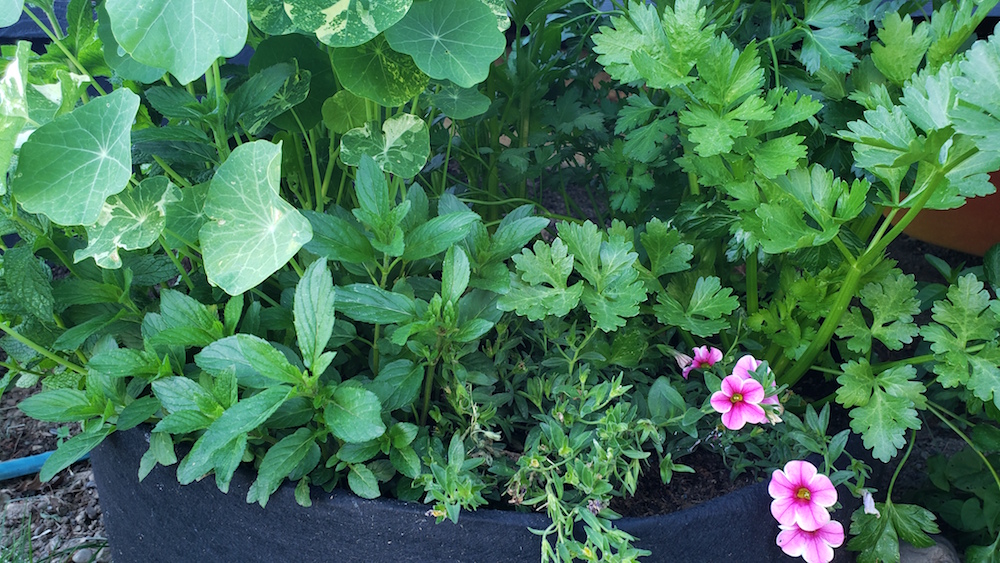
Container gardening is a GREAT way to utilize all the space you have. I have yet to discover a fruit or veggie that doesn’t do well in containers with 6+ hours of sunlight, drainage holes, healthy soil and adequate water.

Grow as many vegetables in the space you have! 
Multiple containers against a fenced in porch.
Place containers just about anywhere- by the door, down the side of your steps, by the mailbox, window/railing boxes, in the corners of your patio. Even if I was farming acres of land I’d still have potted plants around the doors and patio because they are gorgeous, functional and easy to get to.
Keep in mind that herbs and vegetables planted vertically or in containers need regular watering as they can dry out faster than those planted in the ground. Cluster pots and containers for visual appeal and function, then use a simple drip irrigation kit with a timer to water for you. So easy! These kits can be found on amazon for $30. I have one attached to every outdoor faucet!
So at this point you should have an idea of how much fruit/herbs/veggies you are wanting to grow, and for how many people, how much space it should take and where you might place your garden.
Next steps: Grab a notebook or binder to start your first garden journal! How fun!
- Jot down the answers to the above questions in your journal to keep you on track.
- Sketch your garden beds, if you can do it to scale even better. That’s why graph paper exists!
- List out the plants you’d like to include.
- Make a list of all the materials you’ll need to get started. Soil, lumber, containers…
- List out the tools you’ll need. Some garden tools you’ll need moving forward, some you can rent or borrow to get you started.


Where there is a will, there is a way.