

A quick beginners guide to an easy veggie garden. Let’s start that garden of yours!
Ever think it would be nice to grow your own veggie garden, to pick dinner as you’re making it? It’s so rewarding that I urge you to start as soon as possible, like now. I’m here to help.
Here I share a quick guide to the 5 simple basics:
- Sunshine & choosing the right location
- Containers vs raised beds and why you might want both
- soil- what to do with it and how to get it
- my plant strategy
- how to master the watering game.
Let’s do this!
Guys, It really is as simple as a bucket of dirt, a plant, some sun, and water. It can also be as complicated as you’d like to make it. Please don’t let the thought of killing a plant stop you from trying. Seriously, I’ve killed more than my share of innocent plants but I’ve grown even more. I’ve fed a lot of hummingbirds, bees, family members, bugs, and soil in the process. A total WIN if you ask me!
Sunshine and location for a new garden
Veggies usually need 6 to 8 hours of sun per day. A little speckled afternoon shade won’t hurt anybody so no need to stress about this one, just eyeball it.
The benefit of planting in containers is that you can move the plant to a different location at a later point in time if need be. (This is especially handy if you’re growing something like dwarf citrus that might need to be moved indoors to a sunny window in the winter.)
Keep in mind that as the sun travels across the sky the shadows shift. Sun loving plants like tomatoes might prefer a south facing wall so it can get more sun. More delicate plants might like an east facing wall so they can get morning sun then be shaded by midday. If you’re the type that needs precise measurements you can purchase a Soncalc on Amazon for about $20.
You’ll most likely need irrigation so pick a spot that won’t be impossible to get to with an irrigation line from your outside faucet.
Planting beside a wall that may reflect light or retain warmth might be nice for those tomatoes, melons, and such. Just be sure you can reach/access most of your garden via paths if your garden is big or use stepping stones if need be.

Growing plants in containers
Lucky you if you have space and soil for planting directly in the ground! Raised beds are super easy and a little easier to tend to up off the ground. Raised beds should be at least 6 inches deep and up to 18 inches or so. I like to use 2 x 10’s or 2 x 12’s with 2 x 4 joints to make it easy. I prefer to use redwood as it is not only beautiful but resistant to rot. If you use another wood you may wish to treat it with sealant and line the inside with plastic.
My number one gardening tip for those who garden here in the desert is to line the bottom of your raised bed with heavy plastic sheeting found at home improvement stores to keep neighboring roots OUT and keep moisture in. To prevent your garden from turning into an anaerobic swap, only water as much as the plants need, saving loads of water from becoming run off. Bonus!
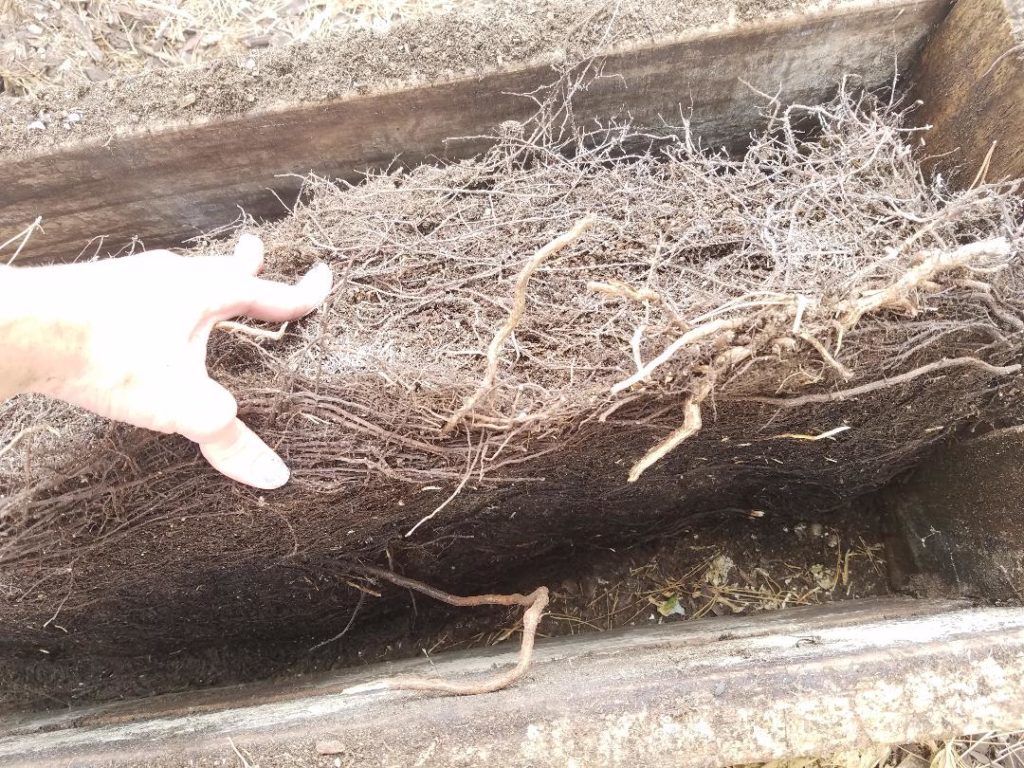
Neighboring trees and oleanders will DESTROY your garden by stealing all of the moisture and nutrients. Not funny. Below is a pic to prove it. 4 inches of roots from the bottom of a 10 inch deep bed, only a few years old. These woody, wiry roots did not belong to my veggies!
Planting in pots and containers have loads of benefits: Planters can be gorgeous, take up less space, easily moved and rearranged, and plants can be separated. For example, mint will grow anywhere it touches and can take over garden bed in no time. Mint is best grown in it’s own container. Strawberries can do this too but no one has ever cried about having too many berries! LOL. Perhaps I am wrong? Sounds like heaven to me.
If space permits, try planting a raised bed with pots as accents. A pot by the kitchen door is a handy spot to keep your herbs.

What soil to use for a new garden bed?
If you’re planting directly in the ground you just need to: remove existing plants (grass) and large debris (rocks and sticks), add compost to revitalize your existing soil, till it somehow (with a shovel, pitchfork, or rent a tiller from a local home improvement store if you have a larger area.) This part can be a bit of a work out but we probably need the exercise and an excuse to get some vitamin D. Regardless, you’ll deserve that cold beverage afterwards! 🙂
If you’re planting in raised beds or in containers simply buy bagged soil from the garden center. How easy was that?! Need a lot more soil than that? You can even have soil delivered to your house and dumped in your driveway. Have your wheelbarrow ready!
Perhaps you inherited a pre filled garden or want to freshen up what you already have. Here’s a helpful article to refresh existing garden soil, quickly and easily.
If you want to know your exact soil pH and nutrients pick up a test kit from the local garden store or send a sample to your state’s extension office for a better analysis. This is certainly worth knowing but not absolutely necessary. Once you have a garden going and you’ve become addicted to understanding more, you can then have your soil tested to better make improvements.
What are soil amendments?
A quick note on soil amendments- amendments are materials added to the soil to improve it. Here’s a brief list of things you can add and why:
- Compost– decomposed organic matter rich in nutrients. Improves soil structure, moisture retention, facilitates production of beneficial bacteria, reduces the need for chemical fertilizers, balance soil pH, reduces pest problems and more. You need this.
- Coconut coir– helps retain water in sandy soils and break up heavy clay soils for better aeration. Made from coconut husks.
- Fertilizer– (found in this order on commercial fertilizers: N-P-K.) N= nitrogen leaf growth. P= phosphorus root development, flowers, seeds and fruit. K= potassium aids over all plant vitality. For example, If you were trying to increase the amount and quality of blooms on your plants you could go with a 2-8-4 fertilizer like Tiger bloom, one of my favorites. If you’re wanting to boost your leafy greens you could go with a 20-5-5. Just be sure to follow directions as too much fertilizer can burn your plants. Hey, why not just add some compost?
- Worm castings a.k.a. worm poop or Vermacast– natural plant superfood, supplies micro and macronutrients, balances soil pH. Better yet, add earthworms to your soil which also help aeration and reduce heavy metals and toxins.
- Epsom salts– source of magnesium. Boosts chlorophyll production which aids blooms and fruit.
- Bone meal– adds phosphorus. Yes it’s made from bones but reduces slaughterhouse waste.
- Blood meal– adds nitrogen.
- Manure– rich in nitrogen but must be properly aged/composted first for about 6 months to reduce ammonia and pathogens like E. coli. Typically high in salts.
- Peat Moss– helps retain water and raises pH. A semi-renewable resource depending on who you ask. I’d choose coconut coir and save peat for smoking malted barley for my scotch. 😉
What NOT to use: wood chips or sawdust as they tie up nitrogen in your soil and are slow to decompose.

How to select plants for a new garden
Seeds or starts?
OK kids, you can plant from seed or head to the plant nursery to buy baby plants (called transplants or starts). How about we do both for a jump start to the season and the instant gratification of seeing green in our garden?
The back of any seed packet purchased at the store will tell you how much sun it likes, when to plant it based on your location, how to plant it, how much water it likes and so on. How convenient is that?
Just a couple great transplants to purchase include: tomatoes, peppers, kale, and my favorite greens- rainbow or Swiss chard.
How do I know what I can plant right now?
Easy. Google a “last frost date” map like this one from Bonnieplants.com. (also a great place to order fun plants) These are the dates your garden is most likely to be hit with frost. You want all of your summer crops to be harvested by then. Simply figure out how many days you have until that first frost date and find varieties that mature in that amount of time or less.
Examples
- Corn takes 60 -100 days to reach maturity depending on the variety.
- Onions 100-175 days.
- Tomatoes 60-100 days.
- Brussels sprouts 80-90 days.
- Okra 50-65 days.
- Pumpkin 90-120 days.
- Beets 45 to 65 days.
Winter crops that can handle frost include
- Spinach
- garlic
- leeks
- arugula
- kale
- cabbage
- brussels sprouts
- broccoli
- radishes and more.
See how easy it is to jump into the gardening game at almost any time?! It’s a little trickier with flowers but I feel there’s always something to plant.
When in doubt, go check it out… head to the local plant nursery to see what they have going on there. Most likely they will be selling what your climate is capable of growing at the moment.
Do tomatoes need cages?
Don’t fool yourself, your tomatoes will need a tomato cage of some sort. You could even loosely tie tomato plants to steaks or a trellis if need be, they can get massive! I had one take over a patio chair once.
For the layout I like to set my plants on top of the garden before planting so I can better visualize the space I will need.
Place taller veggies were they won’t shade smaller plants. Here in the northern hemisphere the sun shines from the south, so placing your garden along the north wall (south-facing) allows you to put taller plants in back and shorter in front so you can watch all of your beautiful little darlings grow grow grow!
What USDA zone are you?
Check out this link to the USDA zone map so you can discover which plants will do best in your garden. Just enter your zip code. This way you’ll have a better idea if a plant can survive in your region. Pretty sure no one in Alaska grows palm trees! LOL
Use all available space
A great way to get the most out of your growing space is to consider planting things close together but strategically. Let me explain: So you plant a tomato that will grow big and tall… so what about all the space around it?
That area is a great place for smaller plants like lettuces, carrots or beets who won’t compete for the same nutrients or are not such heavy feeders as your tomato. These smaller plants act as a living mulch by reducing weeds and aiding in water retention by shading the soil and more. Tell me that’s not awesome.
Don’t forget you can plant in succession so you don’t end up with too much of one veggie come harvest time. For example: plant some beans, then in a few weeks poke a few more beans in the ground, and then again in a few weeks after that. Or plant lettuce starts along with sewing lettuce seeds every few weeks for a continual harvest. Yeah!

How to water (irrigate) your plants
Alrighty, our little babies need water. Unless you have nothing else to do besides tend to your darling garden I suggest you get some irrigation installed. It’s not as scary as it sounds.
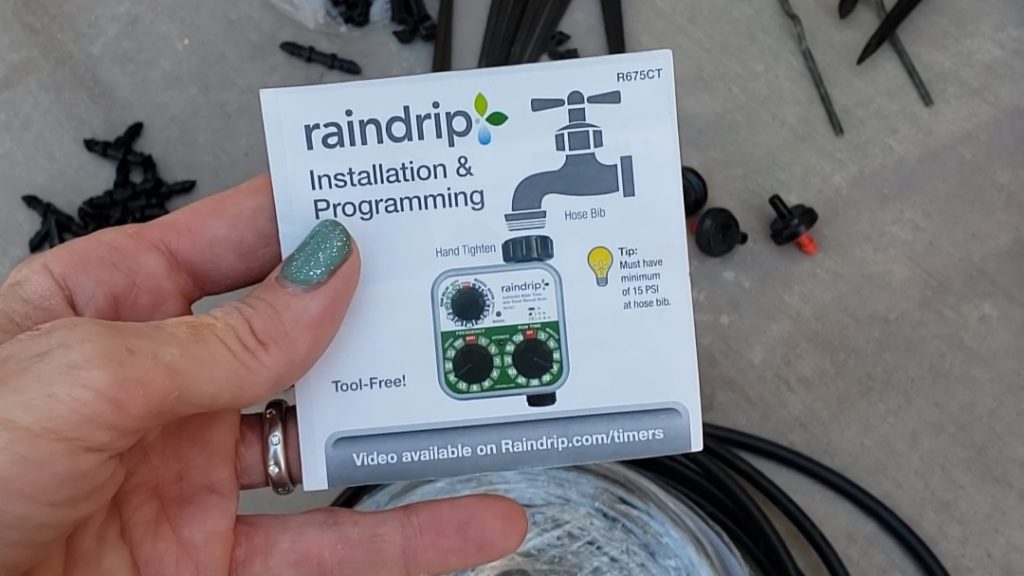
Screw a timer on your faucet and run a line to your garden. Plug in a few emitters. Seriously that’s it. It will cost you $20-$30 and water your container, raised bed or both gardens for you several times a day if you want. Kits come with instructions you can use emitters or soaker hoses- Your call. There are all kinds of specialty fittings you can add for different reasons, although I’ve never needed any.
That’s it! You really could grow a bucket of tomatoes on your front steps if you needed to. A windowsill of fresh herbs. A tub of potatoes by the garage. Once you see how rewarding and surprisingly easy it is to grow your own veggies you’ll see everything as a planting opportunity!
Quick recap: take these 5 things into consideration and you’re on your way to a gorgeous garden!
- Enough sunshine
- Containers/ garden bed
- Soil amendments
- Plants
- Water
Do you need to take a peak at my 12 month planting guide so you have a better idea as to what happens when? I am between USDA Zones 8 & 9. Come sneak a peak at what I’m doing each month so you can see that you really can jump in and start a garden at anytime!
I already LOVE your garden! What have you done already? What are you wanting to plant? Come join the plant party on Instagram @lubba.food.garden XO

Love this! 🥰